









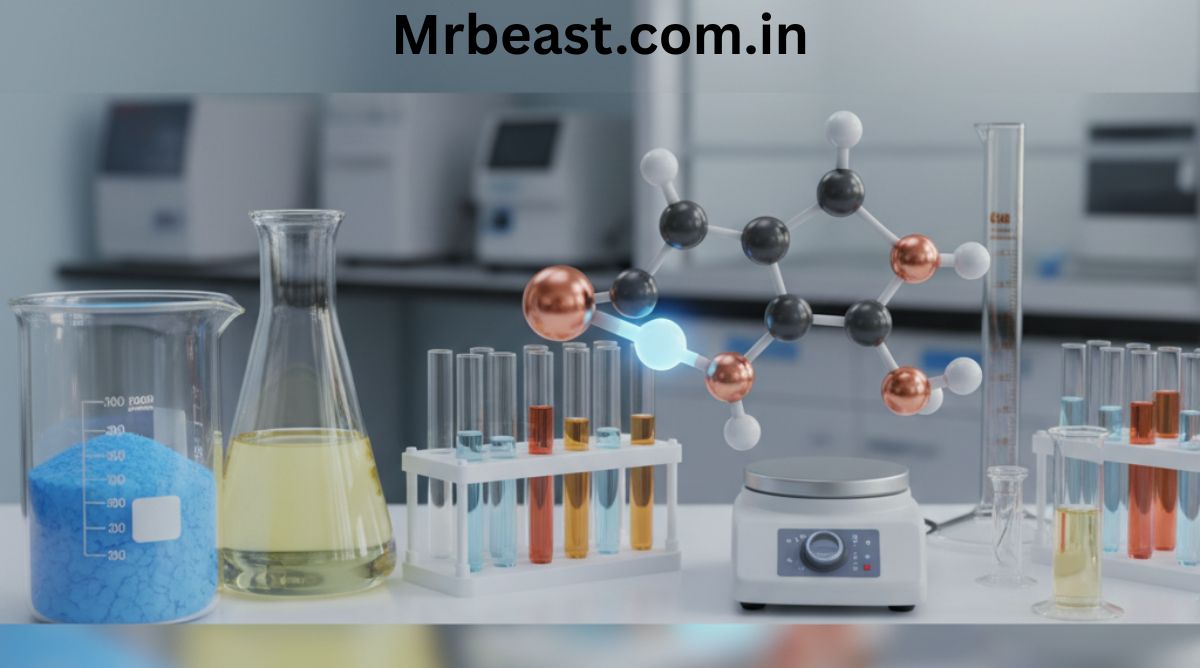
Understanding the role of copper sulfate pentahydrate in chemical reactions, especially in the context of Ellman’s condensation, requires a deep dive into both inorganic and organic chemistry. This article explores the chemistry behind these compounds, their individual functions, and whether copper sulfate pentahydrate can effectively be used in Ellman’s condensation reactions.
What Is Copper Sulfate Pentahydrate?
Copper(II) sulfate pentahydrate (CuSO₄·5H₂O) is a bright blue crystalline solid that serves as one of the most recognizable copper salts in chemistry. It is widely used as a reagent, fungicide, and desiccant, and sometimes as a catalyst in organic reactions.
The pentahydrate form means it contains five water molecules coordinated to each copper sulfate unit. When heated, these water molecules can be lost, converting the compound into anhydrous copper sulfate, a white powder. This dehydration–rehydration cycle plays an important role in its reactivity.
Key Properties
- Chemical Formula: CuSO₄·5H₂O
- Molecular Weight: ~249.7 g/mol
- Appearance: Blue crystalline solid
- Solubility: Soluble in water, slightly soluble in methanol and glycerol
- Melting Point: 110°C (decomposes to the anhydrous form)
Because of its Lewis acidity, copper(II) sulfate can sometimes act as a mild catalyst by coordinating with oxygen atoms in organic substrates, such as carbonyl compounds. However, its hydrated form adds complexity to water-sensitive reactions.
What Is Ellman’s Condensation?
Ellman’s reagent and the Ellman condensation are widely known in organic synthesis and biochemistry. The term “Ellman’s condensation” typically refers to a process used to prepare chiral sulfinimines (also known as Ellman’s imines) from sulfinamides and carbonyl compounds.
This reaction was developed by David G. Ellman as part of his pioneering work in asymmetric synthesis. The resulting sulfinimine intermediates are crucial for synthesizing chiral amines, which are essential in the pharmaceutical industry.
General Reaction
The condensation occurs between:
- A chiral sulfinamide (R–SO–NH₂)
- An aldehyde or ketone (R’–C=O)
The reaction produces a sulfinimine (R–SO–N=CR’R”) and water as a byproduct. Because the reaction releases water, it is typically carried out under anhydrous (dry) conditions to drive the equilibrium toward product formation.
Why Consider Copper Sulfate Pentahydrate for Ellman’s Condensation?
At first glance, it might seem unconventional to use copper sulfate pentahydrate in a condensation that ideally requires a dry environment. However, there are reasons why a chemist might consider experimenting with this compound in Ellman’s condensation:
- Lewis Acid Catalyst: Copper(II) ions act as Lewis acids, which means they can coordinate with oxygen atoms in the carbonyl group of aldehydes or ketones. This makes the carbonyl carbon more electrophilic and more reactive toward nucleophiles like sulfinamides.
- Activation of Carbonyl Group: By activating the carbonyl group, Cu²⁺ could theoretically lower the activation energy of the condensation, increasing yield or reaction rate.
- Cost-Effectiveness: Copper sulfate pentahydrate is inexpensive, stable, and easy to handle, making it attractive for exploratory synthesis.
- Possible Catalyst Recycling: As an inorganic catalyst, it might be reusable after simple filtration and rehydration.
Challenges of Using Copper Sulfate Pentahydrate in Condensation
While the theoretical advantages sound promising, several practical and chemical issues make the direct use of CuSO₄·5H₂O problematic in Ellman’s condensation.
1. Presence of Water
The main drawback is the five molecules of water contained in copper sulfate pentahydrate. Condensation reactions like Ellman’s are water-sensitive because water formation pushes the equilibrium backward, preventing imine formation. Therefore, the hydration water in CuSO₄·5H₂O could actually inhibit the reaction.
To mitigate this, one could use anhydrous copper sulfate, which can be prepared by gently heating the pentahydrate until it turns white. However, even trace moisture can hinder the reaction’s efficiency.
2. Solvent Compatibility
Ellman’s condensation typically takes place in nonpolar or weakly polar organic solvents (like dichloromethane, toluene, or THF). Copper sulfate, being ionic and highly soluble only in water, does not dissolve well in such solvents. This limits its effectiveness as a homogeneous catalyst.
3. Oxidation Risks
Copper(II) ions can oxidize sensitive functional groups, including sulfur-containing compounds like sulfinamides. This could lead to unwanted side reactions or decomposition of the chiral auxiliary.
4. Lack of Literature Support
To date, there are no published reports in major chemistry journals describing the successful use of copper sulfate pentahydrate for Ellman’s condensation. This suggests that while it is theoretically possible, it has not been proven effective experimentally.
Mechanistic Considerations
Let’s imagine, hypothetically, how CuSO₄·5H₂O might participate in Ellman’s condensation.
- Coordination: Cu²⁺ coordinates with the carbonyl oxygen of the aldehyde, increasing the electrophilicity of the carbonyl carbon.
- Nucleophilic Attack: The sulfinamide nitrogen attacks the activated carbonyl carbon, forming a tetrahedral intermediate.
- Dehydration: With the help of mild heat or a dehydrating agent, the intermediate loses water, producing the sulfinimine.
- Product Formation: The copper ion may dissociate, regenerating itself for another catalytic cycle.
However, because copper sulfate pentahydrate itself introduces water into the system, steps (1)–(3) may not proceed efficiently unless the salt is pre-dehydrated.
How To Use Copper Sulfate in Practice (If Attempted)
For an experimental chemist wishing to explore this idea, the following modifications might make the reaction more feasible:
- Use Anhydrous Copper Sulfate – Heat CuSO₄·5H₂O to remove water of crystallization before use.
- Employ Drying Agents – Include molecular sieves or Dean–Stark apparatus to continuously remove water from the reaction mixture.
- Maintain an Inert Atmosphere – Conduct the reaction under nitrogen or argon to prevent moisture reintroduction.
- Select Compatible Solvents – Choose solvents like THF or toluene, which are dry and can solubilize organic intermediates.
- Monitor Reaction Progress – Use thin-layer chromatography (TLC) or NMR spectroscopy to track imine formation.
Possible Alternatives to Copper Sulfate
Several other catalysts or conditions have been used successfully for Ellman’s condensation, including:
- Titanium(IV) isopropoxide (Ti(OiPr)₄) – A strong Lewis acid that efficiently promotes imine formation.
- p-Toluenesulfonic acid (p-TSA) – A mild acid that works under nonaqueous conditions.
- Molecular sieves only – Some methods require no metal catalyst at all, relying solely on water removal to drive the reaction.
Thus, while copper sulfate is interesting from a theoretical standpoint, these alternatives are proven and better suited for water-free condensations.
Environmental and Safety Concerns
Although copper sulfate is a useful laboratory reagent, it poses environmental hazards if not handled properly. According to Wikipedia, copper sulfate is toxic to aquatic life and can be harmful to humans if ingested or inhaled.
- Wear protective gloves and eyewear when handling CuSO₄·5H₂O.
- Avoid release into drains or water systems.
- Dispose of copper-containing waste through approved chemical waste disposal systems.
Final Verdict: Can You Use Copper Sulfate Pentahydrate for Ellman’s Condensation?
After reviewing the chemistry, feasibility, and experimental limitations, the conclusion is no — at least not directly.
Copper sulfate pentahydrate, while an interesting Lewis acid, contains too much water and lacks solubility in organic solvents used for Ellman’s condensation. These factors make it unsuitable as a direct catalyst or reagent for the reaction.
If an anhydrous form of copper sulfate were used under carefully controlled, moisture-free conditions, it might assist as a Lewis acid activator, but this remains speculative. No confirmed or peer-reviewed studies have demonstrated its success in Ellman’s condensation.
Therefore, while chemically possible in theory, it is not recommended in practice without rigorous testing and optimization.